
It’s fashionable to think that the global crypto trading community is always in lockstep with one another—embracing the same coins, and following the same strategies.
However, according to an Aug. 6 report by the crypto and blockchain analytics firm Chainalysis, there are some significant continental differences setting North America apart from its peers in Europe and Asia.
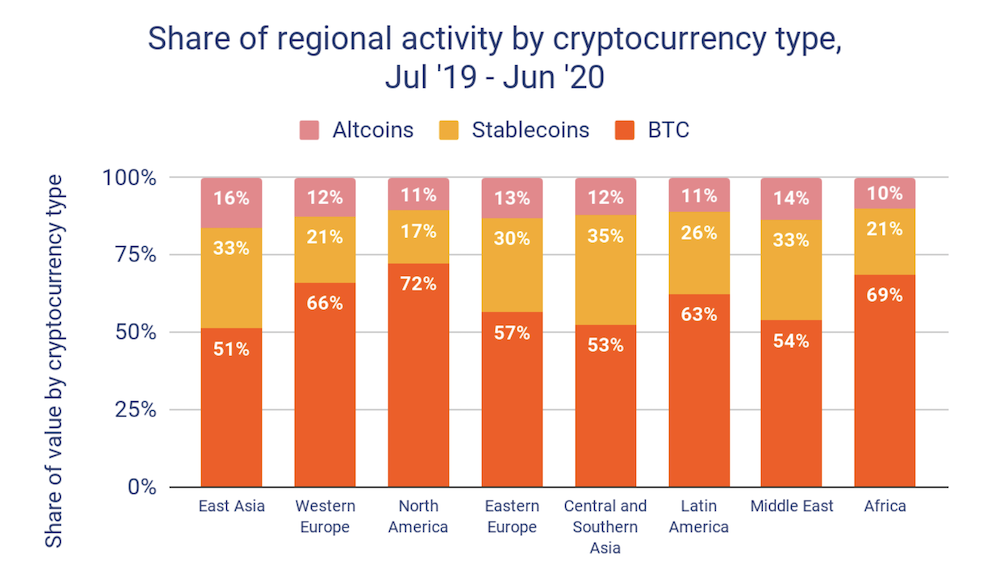
In a preview of its upcoming Geography of Cryptocurrency Report, the company revealed that investors in the U.S. and Canada “disproportionately favor” Bitcoin. The world’s biggest cryptocurrency accounts for 72% of all transaction volume on the continent—considerably more than China, Japan, South Korea, and the rest of East Asia at 61%.
Investors in North America are also more likely to take a dim view of altcoins, as they represent just 11% of activity (stablecoins make up the rest at 17%). By comparison, crypto users in East Asia have almost twice as much exposure to smaller digital assets—with stablecoins representing 33% of activity and altcoins 16%.
Central and Southern Asia are more stablecoin-friendly than the U.S., with 53% bitcoins, 35% stablecoins, and 12% altcoins. The Middle East and Eastern Europe are roughly the same, while Africa and Western Europe is closer to the U.S. with 69% bitcoins and 66% bitcoins respectively.
Hodling for America
Elsewhere in the blog post, Chainalysis noted:
“The data also suggests that North America-based professional and institutional investors tend to buy and hold cryptocurrency moreso than those based in East Asia, who tend to trade at a higher frequency.”
Overall, the research depicts North Americans as Bitcoin lovers who are likely to buy substantial amounts of this cryptocurrency—and are reluctant to sell it. It adds:
“Despite North America-based addresses making up roughly 15% of all cryptocurrency activity globally as of June 2020, behind Western Europe at 17% and East Asia at 31%, North American addresses lead the way in cryptocurrency balances.”
According to Chainalysis, North American crypto addresses hold 29% of all cryptocurrency parked at service-hosted addresses—almost double the wealth that’s stored in East Asia-based addresses. Overall, it seems U.S. and Canadian investors are content with letting BTC sit in their wallets so it can accumulate—an approach that seems astute given how Bitcoin has almost trebled in price since March.
Institutional investors weigh in
Chainalysis’ findings add that North America has a “growing class of institutional investors,” with this share of the market rising sizably in recent years. The authors of the company’s report said this “can be seen by many to legitimize cryptocurrency as an asset class”—potentially giving Bitcoin even more momentum amid speculation that it’s about to embark on a bull run and potentially return to all-time highs of $20,000 set in 2017.
Another snippet of information can be found in the activities of so-called professional investors, defined as those who make crypto transfers worth $10,000 or more at any given time. Overall, roughly 90% of North America’s crypto transfer volumes fell into this category in June.
The company also cited a poll that was carried out by Fidelity Digital Assets that same month, which found almost 80% of institutional investors find something appealing about digital assets.
Both Fidelity and Coinbase have developed tailor-made solutions for institutional investors of late, but according to Chainalysis, their success in dominating this lucrative corner of the market is far from guaranteed:
“As institutional involvement in cryptocurrency continues to grow, it’ll be interesting to see whether the preferred custody options for those investors come from a mainstream financial services company or a crypto-native company.”
Chainalysis said that its full report, which is due to be released in September, will cover inter-regional trading patterns in greater depth—as well as the state of regulation on each continent, and how cryptocurrency mitigates economic instability.
In it for the long haul
When coupled with past research, Chainalysis appears to have detected a running trend: most of those who own Bitcoin regard it as a long-term investment.
Back in June, it found that roughly 60% of the Bitcoin in circulation—approximately 11.4 million, to be exact—has been held for many years. Another 3.5 million is used for trading and moves frequently, and in a worrying development, it’s feared that 3.7 million BTC (worth $43 billion at the time of writing) may have been lost for good. Given that Bitcoin’s entire maximum supply is just 21 million, that’s a sizeable chunk.
Although Chainalysis is better known for helping law enforcement agencies track down illicit cryptocurrency transactions, the company says delving into blockchain data “can also help us analyze cryptocurrency markets to uncover patterns in usage and inform investment decisions.”
In a nod to how bigger investors dominate the space, June’s data also showed that a group of just 13,600 professional traders control the liquidity of the Bitcoin marketplace. Collectively, they’re responsible for 85% of the U.S. dollar value of BTC that’s sent to exchanges.
You May Also Like
-
 September 28, 2020
 -
 January 3, 2018
 -
 December 21, 2017


