
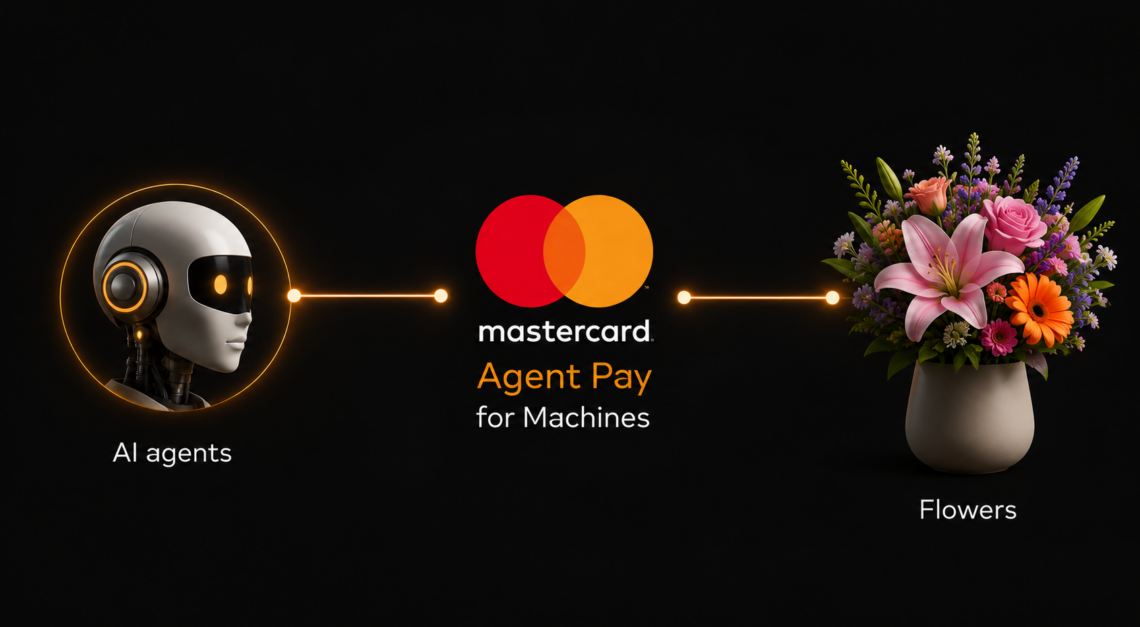
Mastercard has unveiled a new payment system for AI agents, designed to permit secure and permissioned transactions to be settled across its payment network at machine speed.
Agent Pay for Machines (AP4M) envisions a future in which businesses create services AI agents can buy and use. Operating at machine speed, these agents will transact continuously with each other at high speed, executing trains of transactions including microtransactions.
Mastercard said in a statement that it believes this will “unlock a massive new wave of innovation, business models and economic activity, where any company, from solopreneurs to the largest enterprises, can become a virtual powerhouse.”
It gives the example of a florist opening a flower shop instructing an AI agent to build and launch the store’s web site — buying a domain name, choosing a hosting service, collecting images, and building checkout pages all within a predesignated budget. This will turn one human-initiated request into a chain of transactions executed automatically via many providers.
“Payments don’t just increase,” Mastercard said. “They change form. They become continuous, embedded, permissioned, and executed at machine speed. And that creates a new requirement: infrastructure that can keep up.”
AP4M is that infrastructure, Mastercard said. It supports credentialing, controls, and guaranteed settlement across many different payment types, from cards to stablecoins. This lets organizations deploy automated payments with the interoperability, reliability, and governance that the digital economy requires.
“Agent Pay for Machines will create the conditions for a superbloom of AI business models,” said Jorn Lambert, Mastercard’s chief product officer. “Machine payments can make it possible for services to be bought and sold among agents at fundamentally different scales than payments today — very high volumes, very small values, very fast and at extremely low latency.”
Mastercard is working with more than 30 partners to validate priority use cases, establish common rules, and accelerate adoption. These include Aave Labs, Alchemy, Anchorage Digital, Checkout.com, Coinbase, OKX, Polygon, Ripple, the Solana Foundation, and Stripe
“We’re heading toward an economy where most transactions never involve a person at all — machines paying each other, constantly, for things too small to bother a human with. That unlocks business models nobody can build today, but only once the payment layer can keep up,” said Joe Lau, co-founder and president of blockchain infrastructure company Alchemy. “Getting that right is one of the most important problems in tech right now.”
You May Also Like
-
 May 1, 2026
 -

-
 June 3, 2026


